Introducing fabric-utils
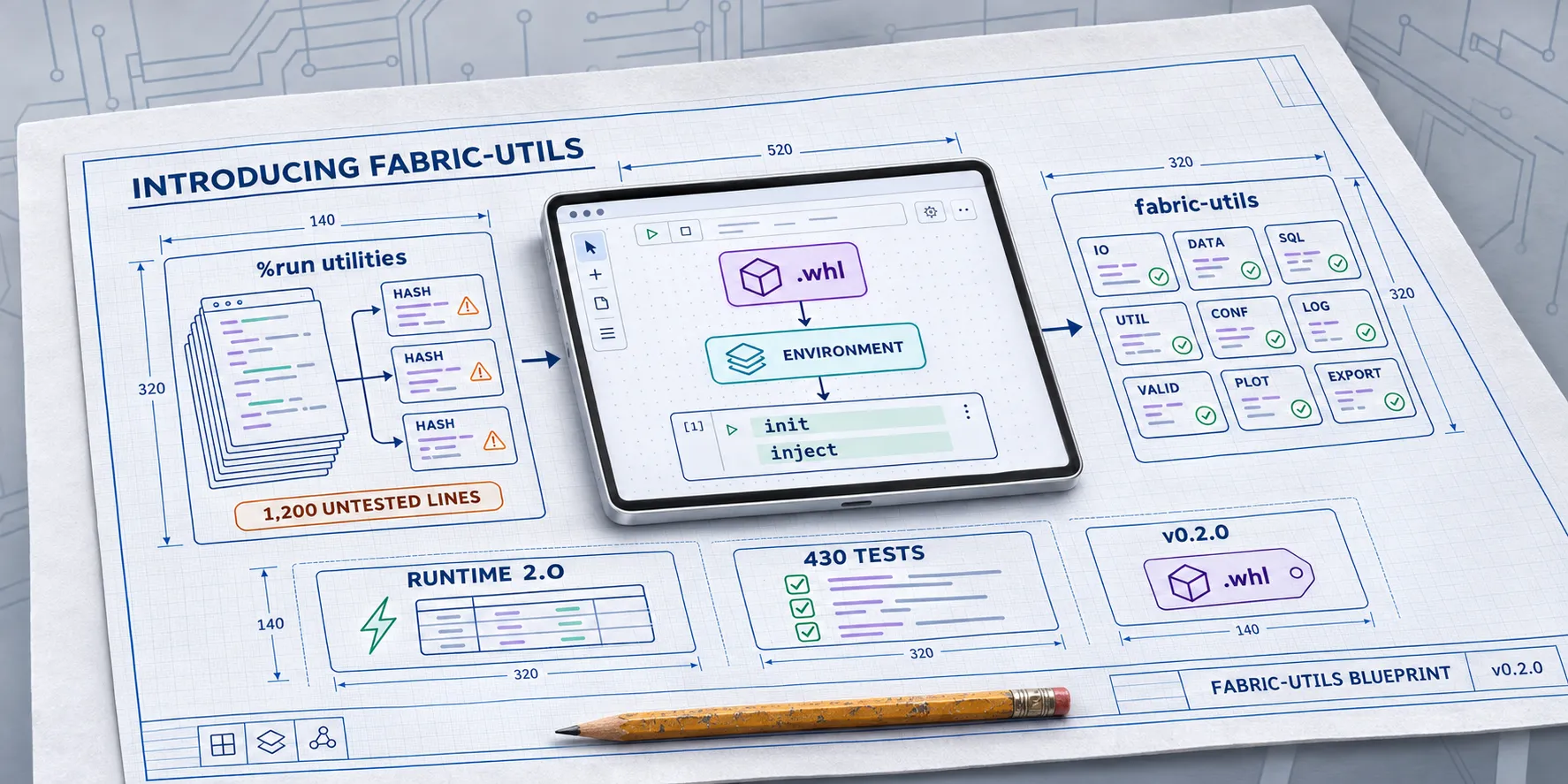
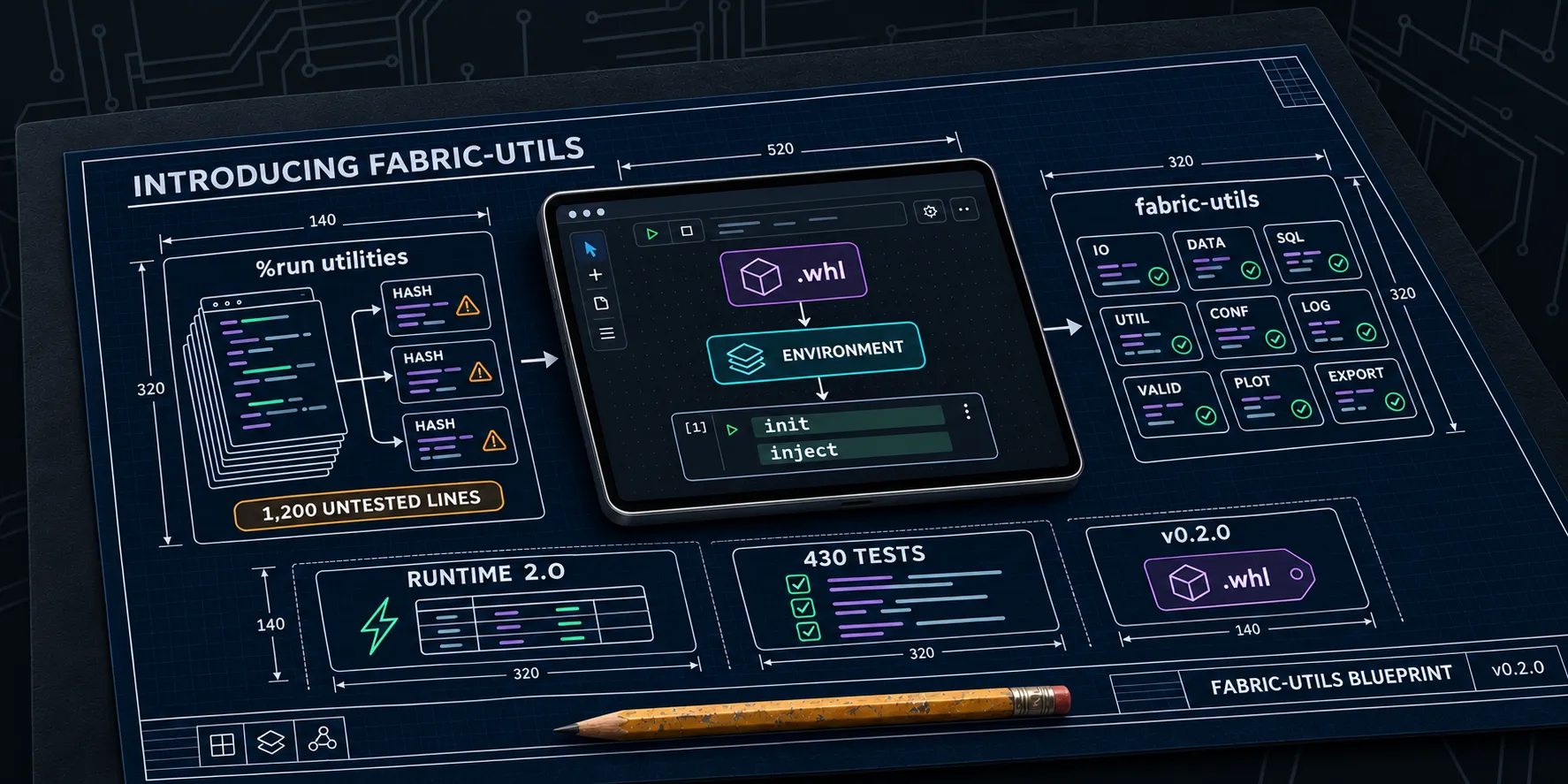
Every Fabric workspace I have worked in grows the same thing: a utilities notebook that every other notebook starts
with %run utilities. It begins as 50 lines of imports. A year later it is 1,200 lines, has three hash functions that
disagree about NULLs, and nobody dares touch it because nothing tests it.
fabric-utils is what I reckon that notebook should have been: a Python package. It is built as a wheel, installed into a Fabric Environment item, and used from a notebook with two lines. Version 0.2.0 went out on 9 November 2026 and the code is on GitHub.
What it targets
Fabric Runtime 2.0 only: Apache Spark 4.1.1, Delta Lake 4.2, Python 3.13, Java 21. Runtime 1.3 is not supported and I am
not going to add shims for it. One runtime means one set of Spark settings, one Delta feature set, and code that can use
Spark 4 functions like try_to_timestamp without a fallback path.
Local development uses the same Python 3.13. PySpark and Delta are an optional extra, because the Fabric runtime already has them. The core dependencies are small: azure-identity, pandas, pyodbc, python-dateutil, requests, and sqlalchemy.
What is in it
inject() populates a notebook’s globals from a registry of named feature sets. Five are on by default, four are
opt-in.
| Feature | What you get | Default |
|---|---|---|
common | F, T, W, DeltaTable, pd, ZoneInfo, datetime, and the rest of the usual imports | yes |
metadata | MetadataConfig and DEFAULT_CONFIG, the single source of truth for column names and hashing | yes |
print_helpers | formatted notebook output | yes |
utils | dates, strings, validation, schema comparison, Delta probes | yes |
contract | NotebookResultContract, COUNTS, and RunTimer for handing results back to a pipeline | yes |
patterns | DataFrame transforms and canonical hashing | opt-in |
lakehouse | lakehouse discovery and Delta maintenance | opt-in |
direct_interface | DirectOrchestrator, a SQL client for the DIRECT orchestration database | opt-in |
keyvault | Key Vault secret retrieval | opt-in |
The two lines
from fabric_utils.autorun import init, inject

init(spark=spark)
manifest = inject(globals(), include={'patterns', 'lakehouse'})
init applies the central Spark settings once per session. inject binds the selected features into the notebook and
returns a manifest of what it put there. Most workspaces keep those lines in one setup notebook and call %run setup.
Why a wheel
A %run helper notebook has no version, no tests, and no type checker. You find out it broke when a downstream notebook
fails at 3am.
A wheel in an Environment fixes all three. Every notebook attached to the Environment gets the same version, and it is
on sys.path before the first cell runs. There is no zip in OneLake and no addPyFile. The version comes from the git
tag through setuptools-scm, so fabric_utils.__version__ tells you exactly what is running. And the package has about
430 unit tests, with the Spark ones running in CI against a real Spark 4.1 session.
The trade is that you cannot edit it in the portal. Fair enough. That is the point.
Rules the code lives by
A handful of rules shape every module. They are in the repo’s AGENTS.md, so the coding agents that help me follow them
too.
import fabric_utilsnever imports PySpark, Delta, pyodbc, or the Azure SDKs. Subpackages load lazily, so the Spark-free parts work in a Fabric Python notebook and in a plain unit test.- There is one hashing implementation. Checksums, business keys, and surrogate keys all come from it.
- Anything that can fail returns a
Result[T]. No alternative result types, no duck typing onsuccess. - No
df.rdd, no_jdf, nosparkContext, noinput_file_name(). The code has to work under Spark Connect. - Delta 4.2 defaults are the baseline. The settings module lists only what changes behaviour relative to Runtime 2.0.
What is coming
One post a week, on Wednesdays. The bootstrap and the feature registry. The Spark settings and why the list is short.
MetadataConfig. How the hashing canonicalises values so a checksum means something. The transforms. Result. The
notebook result contract. Lakehouse maintenance with guard rails. The DIRECT client and its authentication. The rest of
utils. Testing a PySpark library on a Windows laptop. And the release pipeline from git tag to Fabric Environment.
Have a crack at the reference notebooks in the meantime.